 Mushroom Health Hub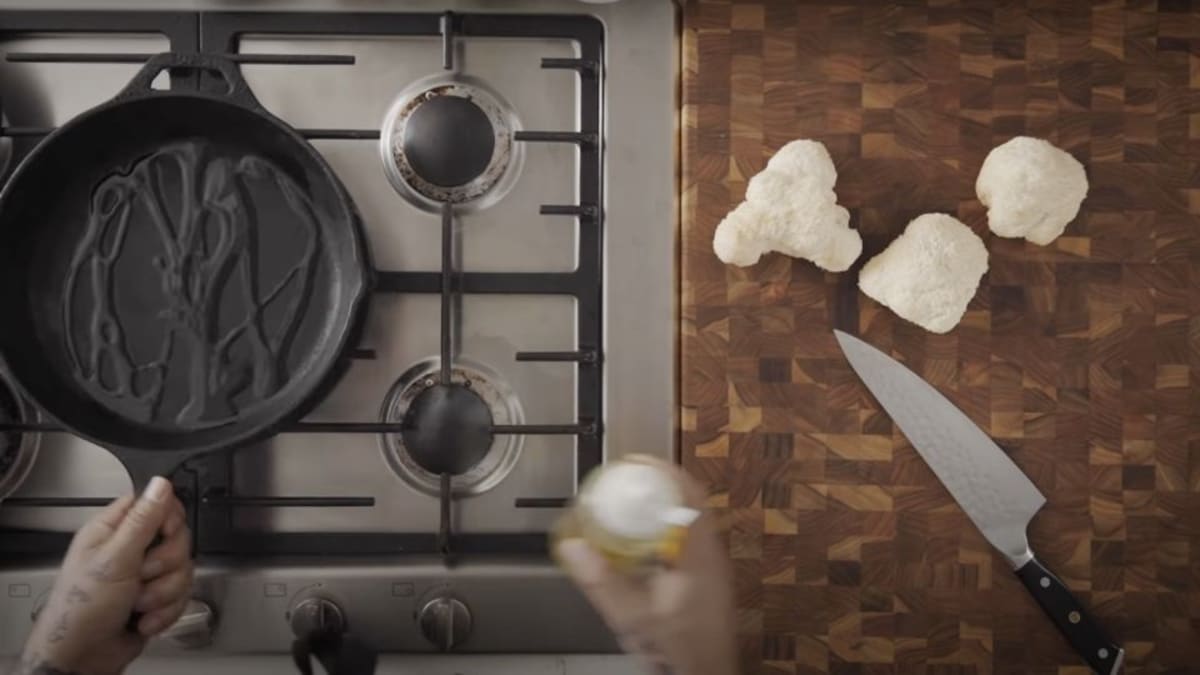
Lion's mane tastes like crab. That's not a metaphor. When you cook it right, the texture pulls apart in dense, moist strands that fool people at the table. We've made these six recipes dozens of times across different seasons of fresh mushrooms, and the thing that separates good results from soggy disappointments is almost always the first 90 seconds in the pan.
The mushroom is Hericium erinaceus, a fruiting-body fungus that grows in shaggy white cascades. Its beta-glucan polysaccharides and hericenone compounds get a lot of attention for brain health, but in the kitchen the more pressing fact is that lion's mane runs about 90% water by weight. That moisture content is why standard sautéing instructions so often fail. You add butter, it pools, the mushroom steams, and the crab-like texture never develops.
Below are six recipes built around the actual cooking behavior of this mushroom. We've also included notes on handling second and third flushes from grow kits, which cook differently and trip up a lot of people the first time.
Key Takeaways
- 1Start every pan recipe with a completely dry, preheated skillet. Add fat only after the mushroom has begun to color. This drives off surface moisture before browning starts.
- 2Hericenones are fat-soluble. Butter and olive oil carry them better than water-based cooking methods, so pan-searing and roasting beat boiling for both flavor and bioavailability.
- 3Second and third flush mushrooms from a grow kit have noticeably higher moisture. Press them between paper towels for 5 minutes before cooking and cut cook time by about 25%.
- 4Slice for pasta and soup, shred or pull for crab cakes, and keep large pieces intact for roasting. The shape affects how fast water escapes and how much surface area browns.
- 5Store fresh lion's mane loosely wrapped in a dry paper towel in the fridge. It keeps about 5 days. Do not seal it in an airtight bag or it gets slimy within 24 hours.
What you need before starting
Fresh lion's mane is the best ingredient here. If you're buying from a store, look for firm white clusters with no yellowing or off smell. A slight earthy smell is normal. Strong ammonia or dark spots mean it's past its peak.
If you're using a grow kit, you can read more about harvesting timing in our lion's mane grow kit guide. Harvest just before the teeth start to brown at the tips. That timing matters for texture in every recipe below.
For equipment, you need a heavy skillet. Cast iron holds heat best for the pan-fry recipe, especially when the cold mushroom hits the surface and you need the temperature to stay high. A standard non-stick will work for the pasta sauce. You'll also want a sheet pan with parchment for roasting, and a large pot for the soup.
If you want to understand the flavor before committing to any of these, our lion's mane taste guide covers the crab and lobster comparison in more detail, including how raw lion's mane differs from what comes out of a hot pan.
The dry-pan technique
Lion's mane releases a large volume of liquid in the first 2-3 minutes of heat exposure. If you add oil or butter before that moisture has started to leave, the pan temperature drops and the mushroom poaches in its own liquid. You get a gray, soft result instead of a golden-brown sear.
The fix is to preheat a dry pan over medium-high for about 2 minutes until it's very hot. Add the mushroom pieces with no fat. You'll hear them sizzle against the dry surface. After 60-90 seconds, they'll start to release moisture and the pan will go quiet. That's when you add butter or olive oil. The mushroom surface has already started to dry, so the fat goes directly to browning rather than pooling.
We started using this after the first few batches came out wrong. The difference was immediate. We've never gone back to starting with oil in the pan, and at this point the dry-start is the single thing we'd pass on to anyone cooking lion's mane for the first time.
Recipe 1 -- Pan-fried lion's mane
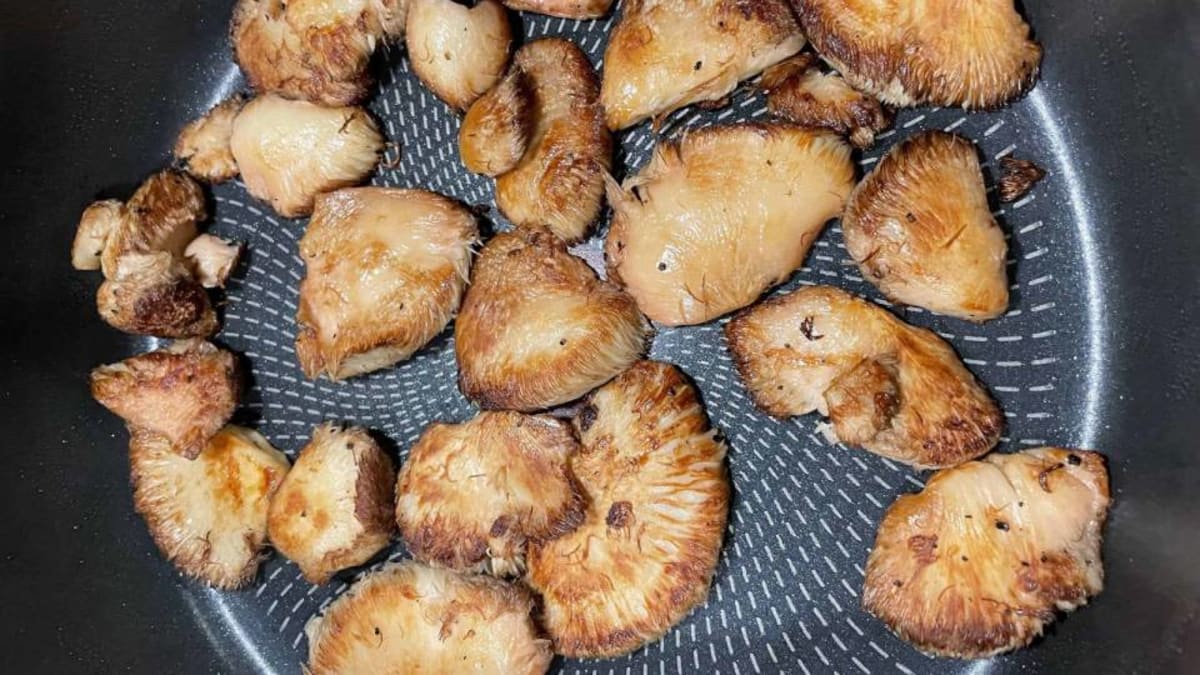
This is the fastest recipe and the one that shows the crab texture most clearly. The slices brown on the outside while staying dense and slightly springy inside.
Prep time: 5 minutes | Cook time: 8 minutes | Serves: 2
Ingredients
- 1/2 pound lion's mane, sliced 1/2 inch thick
- 1-2 tablespoons butter
- 1 tablespoon tamari or soy sauce
- Sea salt and black pepper
Instructions
- Preheat a dry cast iron or heavy skillet over medium-high heat for 2 minutes.
- Place mushroom slices in the dry pan. Do not add fat yet. Let them sizzle for 60-90 seconds until you see some browning on the contact side.
- Add butter. The slices will sizzle harder as the fat hits the hot pan. Cook 3-4 minutes more, turning once, until both sides are golden.
- Add tamari and let it caramelize for about 30 seconds.
- Season with salt and pepper. Serve immediately.
The tamari adds a savory depth that leans into the umami of the mushroom without covering the seafood sweetness. We've tried lemon butter as an alternative and that works well too if you want a lighter result.
Recipe 2 -- Roasted lion's mane
Roasting at high heat does something different from pan-frying. The edges get crispy and almost chip-like while the interior stays tender. This works well as a side dish or added to grain bowls after cooking.
Prep time: 5 minutes | Cook time: 12-15 minutes | Serves: 2
Ingredients
- 8 oz lion's mane, torn or cut into bite-sized chunks
- 2 tablespoons olive oil
- 1 tablespoon fresh thyme leaves
- 1 teaspoon garlic powder
- 1/4 teaspoon red pepper flakes
- Salt and pepper
Instructions
- Preheat oven to 425°F. Line a baking sheet with parchment.
- Toss mushroom pieces with olive oil, thyme, garlic powder, red pepper flakes, salt, and pepper. Make sure every piece has a light coating.
- Spread in a single layer. Crowding the pan is the most common mistake here. Leave at least 1/2 inch between pieces or they'll steam rather than roast.
- Roast 12-15 minutes, turning once halfway, until edges are golden and crispy.
- Eat immediately. They lose their crunch within about 10 minutes.
Recipe 3 -- Lion's mane pasta
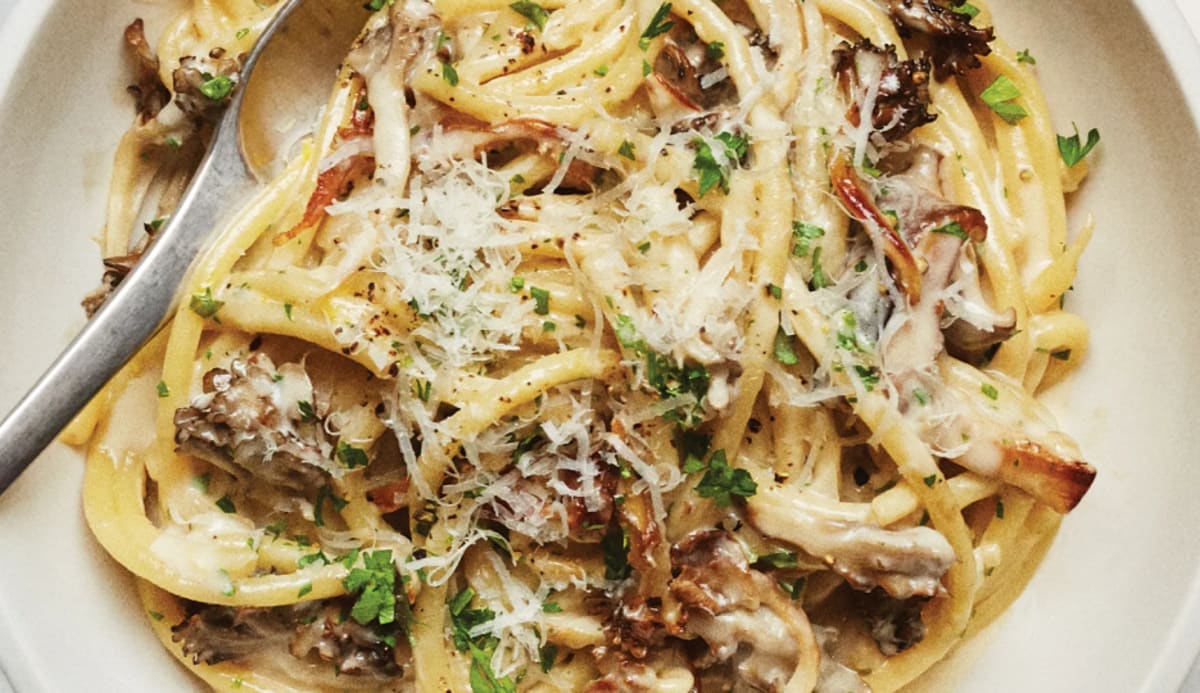
This is probably the most satisfying of the six for a full dinner. The mushroom goes into a simple cream and Parmesan sauce where it soaks up the fat and takes on a richness that makes it feel almost indistinguishable from shellfish in the final dish.
Prep time: 10 minutes | Cook time: 15 minutes | Serves: 2
Ingredients
- 8 oz spaghetti
- 1/2 lb lion's mane, roughly chopped
- 1/2 cup butter
- 2 garlic cloves, minced
- 1/4 cup heavy cream
- 1/2 cup grated Parmesan
- Salt and pepper
Instructions
- Cook pasta per package instructions to al dente. Reserve 1/4 cup pasta water before draining.
- Heat butter in a large skillet over medium heat using the dry-pan method -- add mushroom first before the butter goes in.
- Once the mushroom has started to brown in the dry pan, add the butter. Sauté 3 minutes until golden.
- Add garlic and cook 1 minute.
- Pour in cream and add Parmesan. Stir until the cheese melts into a smooth sauce, about 2 minutes.
- Add drained pasta and toss. Use reserved pasta water to loosen if needed.
- Season with salt and plenty of black pepper.
This dish is why hericenones being fat-soluble matters in a practical sense. Cooking the lion's mane in butter before combining it with the cream sauce means those compounds are already dissolved in the fat, so they spread through the entire dish rather than staying locked in the mushroom tissue.
Recipe 4 -- Lion's mane soup
Broccoli cream soup, lion's mane swapped in where you'd normally use chicken or shrimp. Faster to make than it looks. The lion's mane adds body and a meaty chew that you don't get from broccoli alone, and the whole thing holds well in the fridge for three days, which makes it a solid option for meal prep.
Prep time: 15 minutes | Cook time: 25-30 minutes | Serves: 4
Ingredients
- 6 cups fresh lion's mane, chopped into slices
- 1.5 cups yellow onion, chopped
- 1.5 cups broccoli, chopped
- 4 cups vegetable broth
- 1 cup heavy cream
- 1/2 cup grated Parmesan
- 1/4 cup butter
- 2 garlic cloves, minced
- Salt and pepper
Instructions
- Melt butter in a large pot over medium heat. Add onion and garlic. Cook until soft, about 5 minutes.
- Add lion's mane and broccoli. Stir to combine and cook 3-4 minutes. The mushroom will release some liquid here, which is fine in a soup context.
- Pour in vegetable broth. Bring to a boil, then reduce heat and simmer 15-20 minutes until everything is tender.
- Remove from heat. Use an immersion blender to puree until smooth.
- Stir in cream and Parmesan. Return to low heat until the cheese melts and soup is warmed through.
- Season with salt and pepper.
One thing we found through testing -- blending while the soup is still very hot produces a thinner texture than you'd expect. Let it cool for 5 minutes first. The result is noticeably creamier, and it's an easy adjustment that changes how the finished soup feels.
Recipe 5 -- Lion's mane vegan crab cakes
This is the most technically involved recipe here. Shredded lion's mane gets combined with Old Bay, panko, and a binding agent, then fried until the outside is deeply golden. The interior has the same texture as real crab cake.
Prep time: 20 minutes | Cook time: 10-15 minutes | Makes: 6-8 cakes
For the cakes
- 8 oz fresh lion's mane, shredded by hand into small pieces
- 1/3 cup panko breadcrumbs, plus another 1/2 cup for coating
- 1/4 cup finely diced onion
- 1 tablespoon chopped parsley
- 1.5 teaspoons Old Bay seasoning
- 1 egg or flax egg
- 1 tablespoon vegan mayonnaise
- 1 teaspoon Dijon mustard
- 1 teaspoon Worcestershire sauce
- Salt and pepper
- 1 tablespoon olive oil
For the tartar sauce
- 1/2 cup vegan mayonnaise
- 1/4 cup finely diced dill pickle
- 1 tablespoon capers, drained and chopped
- 1 tablespoon fresh parsley, chopped
- 1 tablespoon fresh chives, chopped
- 1 tablespoon lemon juice
- Salt and pepper
Instructions
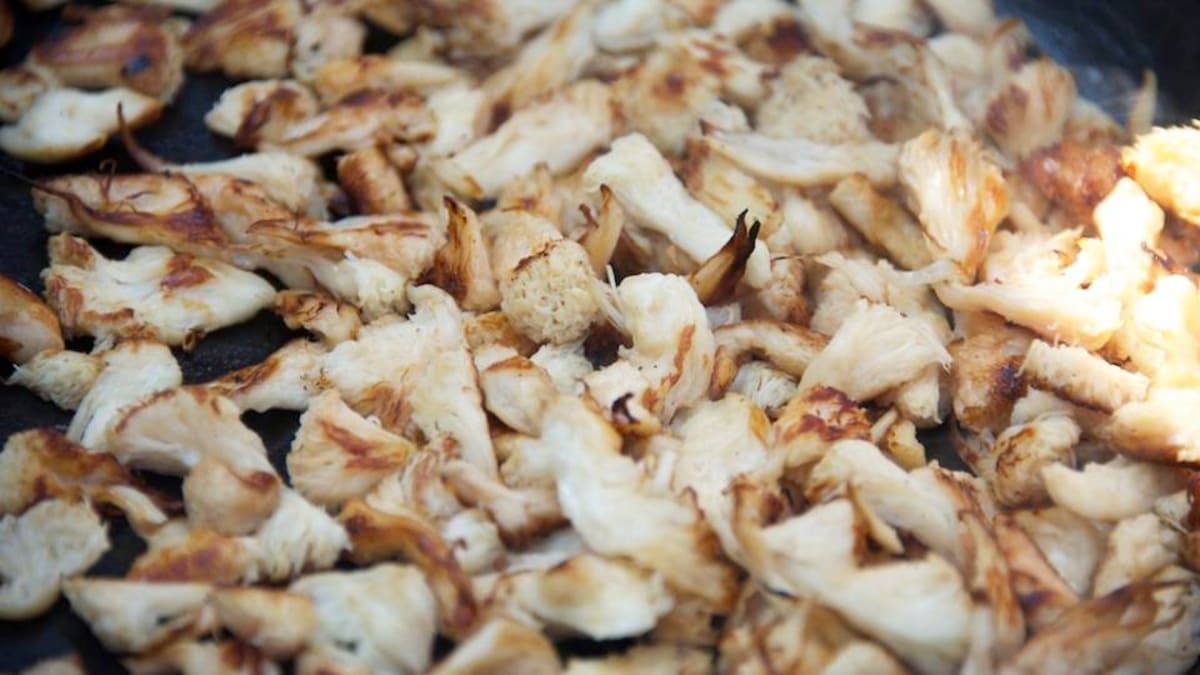
- Shred the lion's mane by hand into pieces roughly the size of crab meat strands. Do not use a knife here. The hand-torn fibers hold together in the cake better than cut pieces.
- In a large bowl, combine the shredded mushroom, 1/3 cup panko, onion, parsley, Old Bay, egg, mayonnaise, mustard, Worcestershire, salt, and pepper. Mix until uniform.
- Form into 6-8 patties, about 3/4 inch thick. Press firmly. Place the remaining panko on a plate and coat each patty on all sides.
- Heat olive oil in a skillet over medium-high. Cook patties 3-4 minutes per side until deeply golden.
- For the tartar sauce, mix all ingredients and refrigerate until ready to serve.
- Serve hot with tartar sauce and lemon wedge.
The hand-shredding step is not optional. We tested with knife-cut pieces and the patties fell apart in the pan. Torn fibers interlock in a way that clean-cut surfaces don't, and once the patty starts to disintegrate mid-cook there's no recovering it -- you end up with a scramble rather than a cake.
Recipe 6 -- Lion's mane Mediterranean salad
This is the lightest dish in the collection. Roasted lion's mane goes over cherry tomatoes, avocado, and red onion with a balsamic dressing. Good for a warm-weather lunch.
Prep time: 10 minutes | Cook time: 15-20 minutes | Serves: 4
Ingredients
- 1 pound fresh lion's mane, cut into bite-sized pieces
- 2 cups cherry tomatoes, halved
- 1 avocado, diced
- 1 small red onion, thinly sliced
- 1/4 cup fresh basil leaves, chopped
- 4 tablespoons olive oil, divided
- 2 tablespoons balsamic vinegar or lemon juice
- Salt and pepper
Instructions
- Preheat oven to 450°F.
- Toss mushroom pieces with 2 tablespoons olive oil, salt, and pepper.
- Roast on a parchment-lined sheet 15-20 minutes, stirring once, until tender and browned.
- In a large bowl, combine roasted mushrooms, cherry tomatoes, avocado, red onion, and basil.
- Whisk together remaining 2 tablespoons olive oil and balsamic vinegar. Pour over salad and toss.
- Serve right away. The avocado will brown if it sits too long.
One variation we come back to in summer -- swap the balsamic for lemon juice and add a small handful of toasted pine nuts. The lemon holds up better against warm mushrooms than balsamic does, and the pine nuts add a crunch that the salad is otherwise missing.
Common mistakes
Adding fat too early is the single biggest problem we see. The mushroom steams rather than browns and you lose the seafood texture entirely. Always start the pan dry.
Crowding the pan works against you in every recipe except the soup. Whether you're pan-frying or roasting, give the pieces room. Surface area touching hot metal or hot air is what drives browning, and pieces packed together just trap steam between them.
Grow kit users often skip moisture adjustment on later flushes. If you grow lion's mane at home, the first flush is firm and dry. The second flush is smaller and noticeably wetter. By the third flush the mushroom can be quite soft with high water content. Press these between paper towels for 5 minutes before cooking. Cut your cook time by roughly 25% and watch closely because they go from golden to overcooked faster than first-flush mushrooms do.
Boiling lion's mane for eating is another mistake we've seen come up. Simmering it in water for broth or tea is fine. But for any dish where you're eating the mushroom itself, boiling produces a waterlogged, gray result with no textural interest. Our lion's mane tea guide covers water-based extraction if that's what you're after.
Washing lion's mane under running water is the last one. The mushroom soaks it up and the excess moisture makes browning nearly impossible. Clean with a dry brush or a barely damp paper towel.
Tips for best results
Get the cooking surface to full temperature before the mushroom touches it. Whether you're roasting or pan-frying, a drop in surface temperature when cold food hits means steam. Not sear.
Salt draws out moisture, so hold off until the mushroom has already taken on color. Adding it at the start extends the time before browning and you'll fight extra liquid the whole way through.
Butter gives a richer flavor and helps with the fat-soluble hericenone compounds in the fruiting body. Olive oil works fine with a slightly more neutral taste. Skip canola and similar oils entirely. The mushroom is mild enough that it needs the fat's own flavor to build on, and if you want to understand just how much the fat choice affects the final taste, try pan-frying the same batch split between butter and canola side by side -- the canola version is noticeably flat.
Second and third flushes from grow kits need different handling. Smaller clusters are normal -- expect maybe 30-40% less yield than the first flush. The texture is softer and wetter. Pressing is not optional here. Skip it and you're back to the steaming problem. These smaller flushes work well in the soup or pasta where the mushroom is cut small anyway. The crab cakes are harder to pull off with wet third-flush mushrooms because the patty binds less reliably.
Fresh lion's mane keeps about 5 days in the fridge. Wrap it loosely in a paper bag or a dry paper towel. Never seal it in an airtight container. Yellow tips or a sour smell means it's past the point of using.
| Method | Best for | Oil or butter | Rough cook time |
|---|---|---|---|
| Dry-pan sear | Standalone dish, pasta | Butter | 6-8 min |
| Oven roast | Salads, side dishes | Olive oil | 12-15 min |
| Soup/braise | Large batches, meal prep | Butter | 25-30 min |
| Shredded patties | Crab cake substitute | Olive oil | 8-10 min |
Frequently Asked Questions

A dedicated wellness researcher who spent decades cataloging the impact of forest-based nutrition on human aging. Ashley doesn't care about trends; she cares about the data.